Microservices Architecture: From Theory to Practice
Master microservices with this beginner-friendly guide. Understand core concepts, solve common challenges, and build with Spring Cloud.

This article is designed for beginners who are new to Microservices architecture. No prior experience with microservices is required. Whether you are a student, junior developer, or a professional looking to transition from monolithic applications, this guide will help you get started.
Microservices architecture is a method of building applications as a collection of small, independent services. Each service is focused on doing one job well and can be built, deployed, and scaled separately. This approach makes it easier to manage and grow large applications.
In this article, we'll bridge theory with practice by exploring microservices concepts through a hands-on example built with Spring Cloud.
Key Benefits of Microservices
Independent Scalability: Scale individual components based on load and usage patterns.
Technology Flexibility: Use different technologies and frameworks best suited for each service.
Isolated Failures: Prevent system-wide outages by isolating faults within a service.
Team Autonomy: Enable teams to develop, test, and deploy services independently.
Continuous Deployment: Deploy services without impacting the entire application.
Core Concepts
Service Boundaries
Each microservice is built around a specific business task, such as managing users or processing orders. Each service has its own database and controls how it stores and accesses data. Services provide their features using APIs, so other services or users can interact with them. Each microservice can be built, tested, updated, and scaled on its own, without affecting the others.
Service Discovery
In dynamic environments, service instances are created and destroyed frequently. A service discovery mechanism ensures that services can locate and communicate with each other without hardcoded addresses.
API Gateway
An API Gateway acts as a single entry point for client requests. It handles routing, load balancing, and cross-cutting concerns like authentication, logging, and rate limiting.
Database per Service
Each service should own its data. This can be implemented using separate databases or isolated schemas to ensure data encapsulation and reduce coupling between services.
Practical Implementation: E-commerce Example
To solidify these concepts, let's look at an example e-commerce application built using Spring Cloud.
Architecture Components
Service Registry (Eureka Server) — Maintains a directory of service instances.
API Gateway — Routes incoming requests to the appropriate services.
User Service — Manages user data and operations.
PostgreSQL Database — Dedicated to the User Service for storing user-related data.
Request Flow
Below is a visual representation of the request flow in our microservices application. It shows how the client request travels through the API Gateway, then to the User Service using the Service Registry, and how the response is returned to the client.
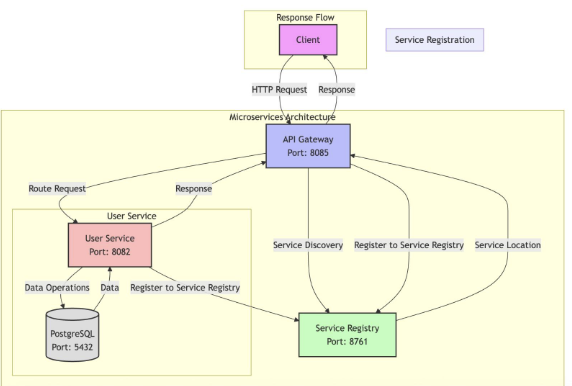
A client sends a request to the API Gateway.
The gateway uses the service registry to discover the target service.
The request is forwarded to the User Service.
The User Service processes the request and interacts with its database.
The response travels back to the client through the same path.
Implementation Highlights
Service Registry (Eureka Server)
The Eureka Server acts as the service registry. Every microservice registers itself on startup and periodically sends heartbeats to stay listed. Other services query Eureka to find the network location of a service by name rather than a hardcoded IP.
To enable the server, add the @EnableEurekaServer annotation to your main Spring Boot class and configure the application.yml with port 8761, setting register-with-eureka and fetch-registry both to false (since the server itself doesn't need to register).
API Gateway Configuration
The API Gateway uses Spring Cloud Gateway to route requests to downstream services by looking up their names from Eureka. Configure routes in application.yml using the lb:// prefix (load balanced) followed by the service name registered in Eureka — for example, lb://USER-SERVICE — paired with a path predicate like /users/**.
User Service Integration
The User Service registers with Eureka and exposes a REST API backed by a dedicated PostgreSQL database. Set a meaningful spring.application.name (e.g., USER-SERVICE) so the gateway can discover it by that name, and point the Eureka client URL to the registry at http://localhost:8761/eureka/.
Best Practices for Microservices
Design Around Business Capabilities: Align services with business domains.
Circuit Breakers: Prevent cascading failures using resilience patterns.
Distributed Tracing: Track end-to-end requests across services.
Centralized Logging: Aggregate logs for better observability.
Containerization: Use Docker for environment consistency.
Infrastructure as Code: Automate environment setup with tools like Terraform.
API Versioning: Ensure backward compatibility with versioned APIs.
Common Challenges and Solutions
Data Consistency
Challenge: Maintaining consistency across services.
Solution: Use event-driven architecture, eventual consistency, and saga patterns.
Network Reliability
Challenge: Unreliable communication between services.
Solution: Implement retries, timeouts, fallbacks, and circuit breakers.
Performance
Challenge: Increased latency due to service interactions.
Solution: Apply caching, asynchronous messaging, and API composition.
Getting Started
Clone the e-commerce microservices repository from GitHub, then start the services in order: Eureka Server first, followed by the API Gateway, and finally the User Service. Each service can be launched with the standard Maven Spring Boot plugin command.
Conclusion
Microservices architecture offers a modular approach to building software that is scalable, resilient, and easy to maintain. By using Spring Cloud, you can implement essential microservices patterns such as service discovery, API gateways, and independent service deployment.
Our example demonstrates how to move from theoretical concepts to a working system — empowering you to build microservices that align with your business goals.
Next Steps
Integrate authentication and authorization.
Add domain services like products, orders, and payments.
Set up observability tools for monitoring and tracing.
Establish CI/CD pipelines for automated deployment and testing.
Originally published on GeekyAnts Blog. Written by Aditya Shekhar, Senior Software Engineer at GeekyAnts.